
Exchange Your Driving Licence in Turkey
Everything you need to swap your foreign licence for a Turkish one in 2026
Yes, you can exchange your foreign driving licence for a Turkish one without taking a driving test, provided your country has a bilateral agreement with Turkey. The process involves getting a sworn translation, a notarised copy, a health report and submitting everything at your local Emniyet traffic branch. Most people complete it within two to four weeks.
I exchanged my own licence back in 2016, and I have since helped dozens of clients through the same process. The paperwork is straightforward once you know which offices to visit and in what order. This guide walks you through every step, lists the current costs, and flags the common mistakes that can send you back to square one.
If you would rather have someone handle the entire process for you, our driving licence exchange service takes care of the translation, notarisation, health report booking and Emniyet appointment. But if you prefer to do it yourself, read on.
Who Is Eligible for a Licence Exchange?
Turkey has bilateral driving licence agreements with a wide range of countries. If your licence was issued by one of these countries, you can swap it directly without sitting a Turkish driving test. The key requirement is that you hold a valid residence permit (ikamet) and are registered at a Turkish address.
Countries with bilateral agreements
The list includes most EU and EEA member states, the United Kingdom, Russia, Ukraine, Belarus, Azerbaijan, Georgia, Kazakhstan, Turkmenistan, Uzbekistan, Japan, South Korea, and several others. The full list is maintained by the Emniyet Genel Mudurlugu (General Directorate of Security) and is updated periodically as new agreements come into force.
Countries without agreements
If your country is not on the list, you will need to pass the Turkish driving test. The most notable omission is the United States; US state licences are not covered by any bilateral agreement. American drivers must sit both a theory exam and a practical test. The theory exam is available in Turkish, English, German and Russian, which makes it manageable even if your Turkish is limited.
Special case: UK licences
British licence holders are in a fortunate position. The UK and Turkey signed a bilateral agreement that survived Brexit, so UK driving licences remain eligible for direct exchange. If you hold a full UK driving licence (not a provisional), you can exchange it following the standard process outlined below.
Special case: Russian licences
Russian driving licences are covered by the bilateral agreement and can be exchanged directly. The process is identical to that for EU licence holders. If your Russian licence is in the older Soviet-era format, you may be asked for additional documentation, but this is rare in practice.

The Six-Month Rule: When You Must Exchange
Turkish law allows foreign residents to drive on their home-country licence for up to six months from the date of their last entry into Turkey. After that, you are legally required to hold either a Turkish driving licence or a valid International Driving Permit (IDP).
In practice, the six-month clock resets every time you leave and re-enter Turkey. Some long-term residents have relied on this loophole for years, crossing the border periodically to reset their driving eligibility. While this technically works, it is not a sustainable strategy. Traffic police are increasingly aware of it, and if you are involved in an accident while driving on an expired foreign licence, your insurance may refuse to pay out.
The consequences of driving beyond the six-month limit include fines (updated annually, typically around 2,000 to 3,000 TL as of 2026), potential vehicle impoundment, and the insurance void mentioned above. I have seen clients face five-figure bills after accidents because their insurer argued the policy was invalid. It is simply not worth the risk.

International Driving Permit as a Stopgap
An International Driving Permit (IDP) is valid in Turkey for six months and can be a useful bridge while you arrange the full licence exchange. You must obtain your IDP from your home country before travelling; Turkey does not issue IDPs to foreign residents.
Bear in mind that an IDP is not a standalone document. It is a translation of your existing licence and must be carried alongside the original. If your original licence has expired, the IDP is worthless. Also, the IDP cannot be renewed or extended in Turkey, so it is very much a temporary solution.
For anyone planning to stay in Turkey longer than six months, I always recommend starting the licence exchange process as early as possible. The paperwork takes time, and you do not want to find yourself in a position where both your six-month grace period and your IDP have expired.
Step-by-Step Exchange Process
Here is the complete process from start to finish. I have listed the steps in the order you should complete them; doing them out of sequence can cause delays because some documents have expiry dates.
Step 1: Sworn Translation (Yeminli Tercume)
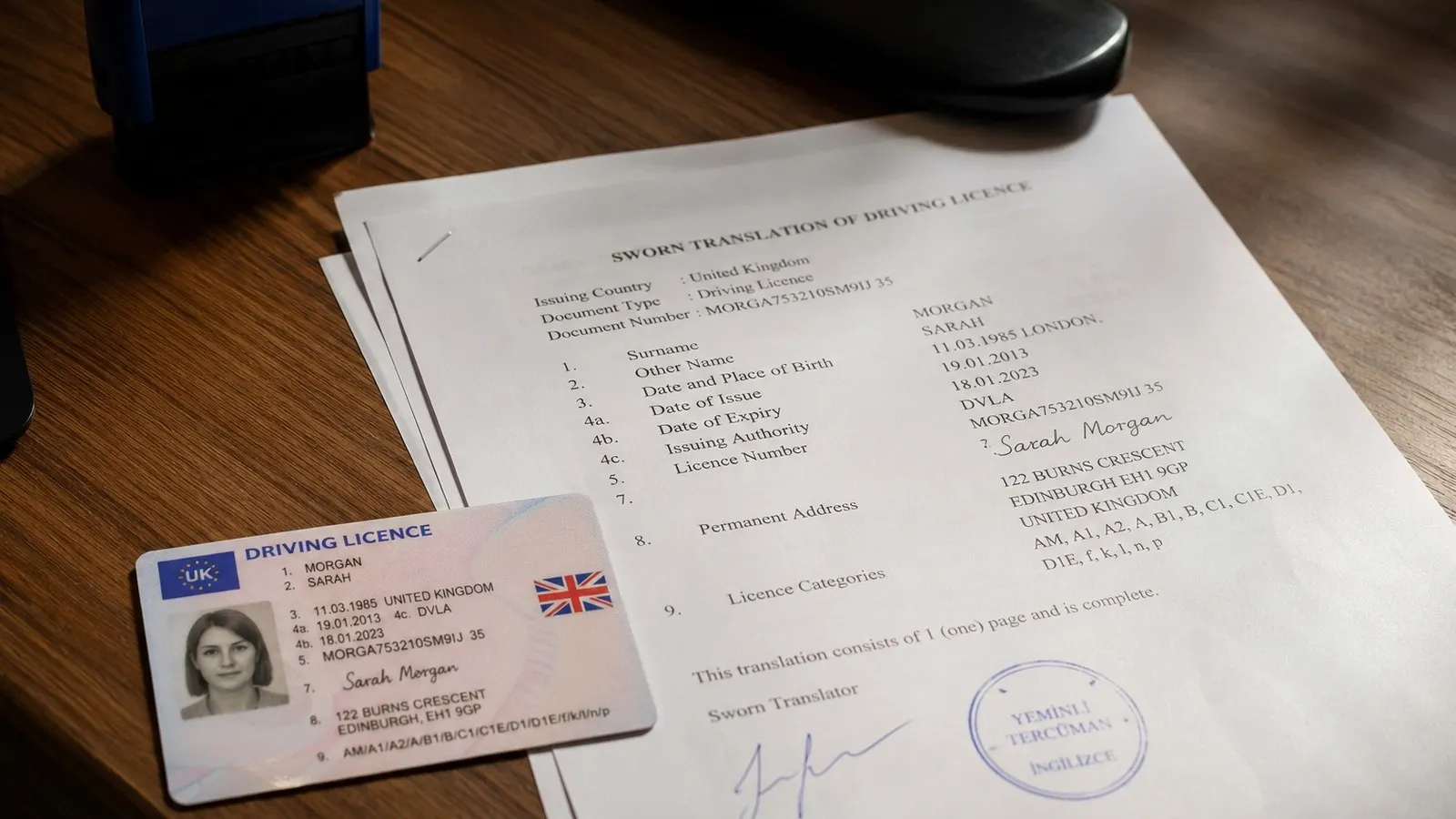
Your first stop is a yeminli tercuman, a sworn translator authorised by a Turkish court. They will translate your driving licence into Turkish and stamp the translation with their official seal. You need the original licence (not a photocopy) for this step.
Sworn translators are found in every Turkish city. Your local courthouse usually has a list posted, or you can search online. Expect to pay between 800 and 1,200 TL for a driving licence translation in 2026, though prices are higher in Istanbul and Ankara. The translation itself takes anywhere from a few hours to two working days.
If you need help finding a reputable sworn translator, our certified translation service can handle this for you. We work with vetted translators across Turkey and can often arrange same-day turnaround.
For a deeper understanding of how sworn translation works in Turkey, see our guide on sworn and certified translation.
Step 2: Notarisation
Once you have the sworn translation, take it to a Turkish noter (notary) for notarisation. The notary will verify the translator's seal, stamp the document with the notary's own official seal, and record the transaction in their register.
Notarisation costs around 300 to 500 TL and is usually completed within the hour. You will need your passport and residence permit when visiting the notary. Some notaries also ask for a photocopy of the original foreign licence.
If you are unfamiliar with how Turkish notaries operate, our guide on how Turkish notaries work explains the system in detail. You can also use our notary assistance service if you would like someone to accompany you and handle the Turkish-language communication.

Step 3: Health Report (Saglik Raporu)
You need a saglik raporu (health report) specifically for driving licence purposes. This must come from a full hospital, either a devlet hastanesi (state hospital) or an accredited private hospital. Small neighbourhood clinics and family doctors cannot issue this type of report.
The examination typically covers:
- Eye test (visual acuity, colour blindness screening)
- Blood pressure measurement
- General physical examination
- Hearing test (at some hospitals)
- Psychiatric assessment (usually a brief interview)
The health report costs between 1,500 and 2,500 TL at a private hospital. State hospitals are cheaper (around 500 to 800 TL) but usually involve longer waiting times. The report is valid for six months, so do not get it too early in the process.
A practical tip: go to the hospital early in the morning, ideally when it opens. You will need to visit several departments, and each one has its own queue. Starting early means you can usually get the whole report done in a single morning rather than having to come back the next day.
Step 4: Address Registration at Nufus
The Emniyet will check that your address registration is current before processing your licence exchange. Visit your local Nufus Mudurlugu (population directorate) to confirm your registered address matches where you actually live.
If you have moved since your last registration, you will need to update it before applying for the licence exchange. Bring your residence permit, passport, and proof of address (a utility bill or rental contract). The address update is free and usually takes about 30 minutes.
Your address registration is also tied to your residence permit, so if your ikamet is due for renewal, it makes sense to sort both at the same time.
Step 5: Application at Emniyet Traffic Branch
This is the main event. You need to visit the Emniyet Trafik Tescil Sube Mudurlugu, which is the traffic registration branch of the police. This is not the regular police station; it is a separate office that handles vehicle registration, driving licences and traffic matters.
You can find your nearest traffic branch through the e-Government portal or by searching for "trafik tescil" plus your city name online.
Bring all of the following documents:
- Original foreign driving licence
- Sworn translation of the licence (notarised)
- Health report (saglik raporu)
- Residence permit (ikamet)
- Passport (original and photocopy)
- Nufus address confirmation
- Four biometric passport photos (see photo requirements below)
- Turkish tax number (vergi numarasi)
The application fee is paid at the Emniyet or at a nearby bank. As of 2026, expect to pay around 600 to 900 TL. The exact amount depends on the licence category you are applying for.
One important thing to understand: the Emniyet will confiscate your original foreign licence during the exchange. They send it back to the issuing country through diplomatic channels. Make sure you have a clear photograph or certified photocopy of the original before you hand it over. You will not see it again.
Step 6: Collect Your Turkish Licence
After submitting your application, the Emniyet will process it and order your new Turkish driving licence card. This typically takes two to four weeks. Some branches issue a temporary paper permit (gecici surucu belgesi) that allows you to drive legally while you wait for the plastic card.
You will receive an SMS when your licence is ready for collection. Go back to the same Emniyet branch with your residence permit and passport to pick it up. The licence card is the standard EU-format card with your photo, personal details, and the licence categories you are authorised to drive.
Biometric Photo Requirements
The Emniyet requires four biometric passport photos. These must meet the following specifications:
- Size: 50mm x 60mm (Turkish biometric standard)
- White background
- Taken within the last six months
- Face clearly visible, no glasses (unless medically required)
- No head coverings (religious head coverings are permitted if the face is fully visible)
- Neutral expression, mouth closed
Most photography shops near government offices know the exact specifications. Ask for "ehliyet fotografi" (driving licence photos) and they will get the format right. Do not use photos from a self-service booth; they often fail the Emniyet's quality checks.
Licence Categories
Turkish driving licences follow the EU category system. When you exchange your foreign licence, you will receive the equivalent Turkish categories. The most common is B class, which covers passenger cars up to 3,500 kg.
Here are the categories you are likely to encounter:
- A1 - Motorcycles up to 125cc
- A2 - Motorcycles up to 35 kW
- A - All motorcycles
- B - Passenger cars and light vehicles up to 3,500 kg
- C - Heavy goods vehicles over 3,500 kg
- D - Buses carrying more than eight passengers
- BE, CE, DE - Respective categories with trailers
If your foreign licence includes categories beyond B (such as C for lorries or D for buses), these will normally be transferred to your Turkish licence as well. However, the Emniyet may require an additional health check for higher categories, particularly C and D.
Cost Breakdown (2026 Prices)
Here is what you can expect to spend on the entire licence exchange process in 2026. These are typical prices; costs vary slightly between cities, with Istanbul and Ankara generally being at the higher end.
| Item | Cost (TL) | Notes |
|---|---|---|
| Sworn translation | 800 - 1,200 | Depends on language and city |
| Notarisation | 300 - 500 | Standard notary fee |
| Health report (private hospital) | 1,500 - 2,500 | State hospitals are cheaper (500 - 800 TL) |
| Biometric photos | 100 - 200 | Four photos required |
| Emniyet application fee | 600 - 900 | Varies by licence category |
| Total estimate | 3,300 - 5,300 | Approximately 85 - 135 EUR |
These costs do not include transport to and from the various offices. If you are in a large city, you may also want to budget for parking, which is ironic given the subject matter.
Our licence exchange service handles the entire process for a fixed fee, which can work out more economical once you factor in time off work and transport costs.
Common Mistakes to Avoid
Having guided many clients through this process, I see the same mistakes come up repeatedly. Here are the ones to watch out for:
Going to the wrong Emniyet office
The driving licence exchange is handled by the Emniyet Trafik Tescil (traffic registration branch), not the regular Emniyet branch where you get your residence permit. These are often in completely different locations. Check the address carefully before you go.
Getting the health report from a small clinic
The saglik raporu must come from a full hospital with multiple departments. A report from a small clinic or aile hekimi (family doctor) will be rejected. Make sure the hospital can issue a "surucu belgesi icin saglik raporu" before you pay for the examination.
Forgetting to photograph your original licence
Your original foreign licence will be confiscated. If you do not have a copy, you will have no record of your original licence number, issue date, or categories. Take clear photos of both sides before you hand it over.
Letting the health report expire
The health report is valid for six months. If you get it too early in the process and then experience delays with the translation or notarisation, the report may expire before you reach the Emniyet. I recommend getting the translation and notarisation done first, then the health report, and then going straight to the Emniyet.
Not updating your address registration
If you have moved since your last Nufus registration, the Emniyet will flag a mismatch between your registered address and your residence permit address. Update your address at Nufus before applying.
Planning to Buy a Car?
If you are exchanging your licence because you plan to buy a car in Turkey, our comprehensive guide on buying a car in Turkey covers everything from choosing between new and second-hand vehicles to the notary transfer process, insurance requirements, and annual vehicle inspections.
You do not strictly need a Turkish driving licence to buy a car in Turkey; ownership and driving rights are separate legal matters. However, having a Turkish licence makes the insurance process smoother and avoids the complications that can arise if you are involved in an incident while driving on a foreign licence.